
Ever heard someone mention the regions of Scottish malt whisky and not really understood what they meant? How does an Islay differ to a Speyside, and how does a Lowland compare against a Highland? Each of the different regions of Scotch has its own distinct story, its own flavour profile and its own dedicated fans, but how did the regionality come about and what does it matter?
There are 5 recognised regions according to the Scotch Whisky Association (SWA) when it comes to malt production in Scotland, and an unofficial 6th. The 5 are Islay, Highland, Speyside, Lowlands and Campbeltown. The 6th, recognised by some but not all, and crucially not by the SWA, is the Islands, which would include Skye, Mull, Jura, Arran, Orkney (not Islay as it gets its own region) and some of the others that are developing distilleries. Instead, they are included within the larger Highland region, but we’ll come back to that later. The largest region in terms of size is Highland, whilst Speyside is the most densely populated in terms of distilleries, although it only became its own region in 2014 having been previously included within the Highland region. Islay has perhaps the most distinctive flavour profile (peaty and smoky) whilst the Lowlands doesn’t carry the name recognition or fame of its brethren, it’s fast becoming one of the most popular, particularly for newer entrants to the whisky scene who favour its lighter style. At one-point Campbeltown called itself the whisky capital of the world and had over 30 distilleries, an impressive number for such a small part of the country, but the count at the moment is just 3, although more are in the pipeline for the future.
What does a region mean for a whisky then? Scotland is a country made up of different geographies, cultures and climates, and that is reflected in the whisky regions. Historically, many of the whiskies in a region would have a similar flavour profile, a similar manufacturing process and would share a similar ancestry. The proximity of distilleries within a region allowed them to share (or perhaps “borrow”) expertise and ideas, meaning that those distilleries would share comparable fermentation and distilling processes, as well as likely using the same water source, barley and possibly staff. The challenges for all distilleries in a region were almost identical, as were the opportunities. Islay has a vast, but not inexhaustible, supply of peat which led to the famous Islay smoky flavour that is beloved by so many. Speyside came to be the powerhouse region because it had a plentiful and high-quality freshwater source (that would be the Spey) and was close enough to Inverness to allow easy trade to the rest of the British Isles. On the other hand, the Highlands and Campbeltown struggled because of poor transport links (it’s not significantly better today) and a lack of infrastructure which partly led to the massive drops in distillery numbers in those regions throughout the late 19th and early 20th century. But their isolation meant the need and desire for their own whisky was great.
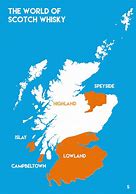
Now we’ve touched on the common histories of the regions, we can move onto the flavours and how they vary between regions. As mentioned before, the peat supply on Islay has given us the famous smoky Islay whiskies of Laphroaig, Ardbeg and Lagavulin as it’s readily used in the drying out of the barley. The Islay whiskies also get a slight maritime and salty punch from the sea air which permeates everything on the island, including the peat and the warehouses. Some Highland whiskies can also gain this saltiness given their usual proximity to the wild coasts of the North and West of Scotland, but others lack it completely and instead rely on the flavours picked up from the glens and hills. Dalwhinnie might be the coldest distillery in Scotland given its isolated location and the whiskies from there will have a very different maturation experience, and therefore flavour, than say an Oban, found down at sea level and mere metres from the shore. A number have incorporated peat (Talisker, Ledaig, Ardmore), whilst others have kept away from it and fit closer to the Speysides. Only a few are masters of peated barley though, so some Highland distilleries like Glen Ord produce peated barley for others to use. Basically, the Highland whiskies have a little bit for everyone, it’s just a case of finding the one you want.
For the Speysides, they have gone for the more-rounded classics, not too harsh or in-your-face, and yet not as light as we expect from the newer Lowland whiskies. Given the sheer number of distilleries in Speyside, there’s quite a range of flavours out there, but the bases are relatively similar and it’s in the detail and more developed aromas that differences start to come out. And for Campbeltown, they’ve got the mix. With only the 3 distilleries, it’s just not an extensive mix. The trendy Springbank has some gentle peat flavours that percolate, as does Kilkerran (produced at Glengyle), whereas Glen Scotia has the saltiness and more lighter flavours that might be associated with other regions, although it can be said that all 3 share a similar “oily” profile. That leaves the Lowland, and because of their immense and readily available supply of barley, and lack of peat, they tend to be seen as lighter and grassier, with more floral tones coming through in their whiskies than what would usually be expected from the other regions. The Lowland whiskies have historically been a mainstay of many blended whiskies, but their single malt market is growing year-on-year and is becoming a favourite of newcomers and experienced sippers.
And what of the Islands? As noted previously, the SWA includes them within the Highlands region and so that remains the official position. However, the number of distilleries in the Islands is increasing quickly and soon may well justify its own category. With Harris, Lerwick, Abhainn Dearg (on Lewis) and Torabhaig all recently producing or about to produce their first single malts, the number of active (or soon to be active) distilleries in the Islands stands at around 14, with plenty of interest for more. There’s generally no flavour profile that links the Island distilleries though, only the fact that they are all completely surrounded by water, and that they aren’t Islay (for good or bad). Is that enough to convince the SWA to give them their own region? Many believe it is, and being an Islander myself, of course I agree with them.
Over time, we see distilleries change their processes to fit into a different modern whisky landscape and some of the characteristics which have previously defined regions have become less important or regimented. Bunnahabhain sets itself apart from the other Islay whiskies by not relying on peat for their core products (although they do have peated whiskies), and conversely, many Speyside whiskies have started to add peated varieties to their collections (BenRomach have their Contrasts range, while Balvenie produces a peated whisky for one week every year during The Week of Peat). But at the heart of it all, while the lines have become less defined, regionality still has its impact and the importance of grouping malts hasn’t diminished. The Lowlands is a fast-developing region in terms of new distilleries (like Glasgow Distillery, Holyrood and Lochlea) and reopened ones like Bladnoch and it’s a safe assumption that most (but not all) of the new malts will keep the lighter, grassier flavours that the region is generally known for because that is the market they are targeting. Both Speyside and Islay host huge whisky festivals meant to show off the very best of both regions and they attract both enthusiasts and novices in their droves. The impact on marketing shouldn’t be ignored. Despite the growth of the malt whisky audience in recent years, there’s still a great battle to win the hearts, minds and cash of the whisky loving public. Many distilleries will lean into their region in the hopes of creating and exploiting their niche in the market.
So should the region matter to you, the whisky lover? Much like most things in whisky, it’s completely up to you. Maybe you can’t think of anything better than the strong peaty flavours from Islay, or maybe you love the rugged salty whiskies from the Highlands, and so you have your regional preference and that’s fine. Maybe you found a whisky you liked and stuck to that region for a while. For me, I fell into the Speysides early and found the quickest way to expand my whisky experience was to keep in that region. Over time I branched out, but having a haven on the banks of the Spey always gives me something to fall back on in a moment of indecision. When I feel like it, I can go for the Islay or the Highlands or to the Mull of Kintyre, and even to the expanding Lowlands. It’s also worth noting that for all the talk of regionality, there is no legal requirement for distilleries to put the region on the label of a bottle, although some will make sure they mention it. Next time you pick up a bottle, see if it has the region noted. A quick glance at my shelf shows an almost 50-50 spilt in whether or not the region is named.
The regionality of Scotch whisky has its place in the story of malt whisky. It helps to tie or bind some distilleries together, whilst also allowing distilleries to promote a sense of local identity and pride. It gives whisky lovers something to bond, or debate, over a dram. As the industry continues to grow and borders, whether real or perceived, are broken down, we see influences from regions impact the others. I doubt it’ll reach the stage where the regions each lose what makes them special and often unique, but maybe the lines will be that bit blurrier. And not just because we’re all on our 4th dram.
 Sean black - Freelance writer